

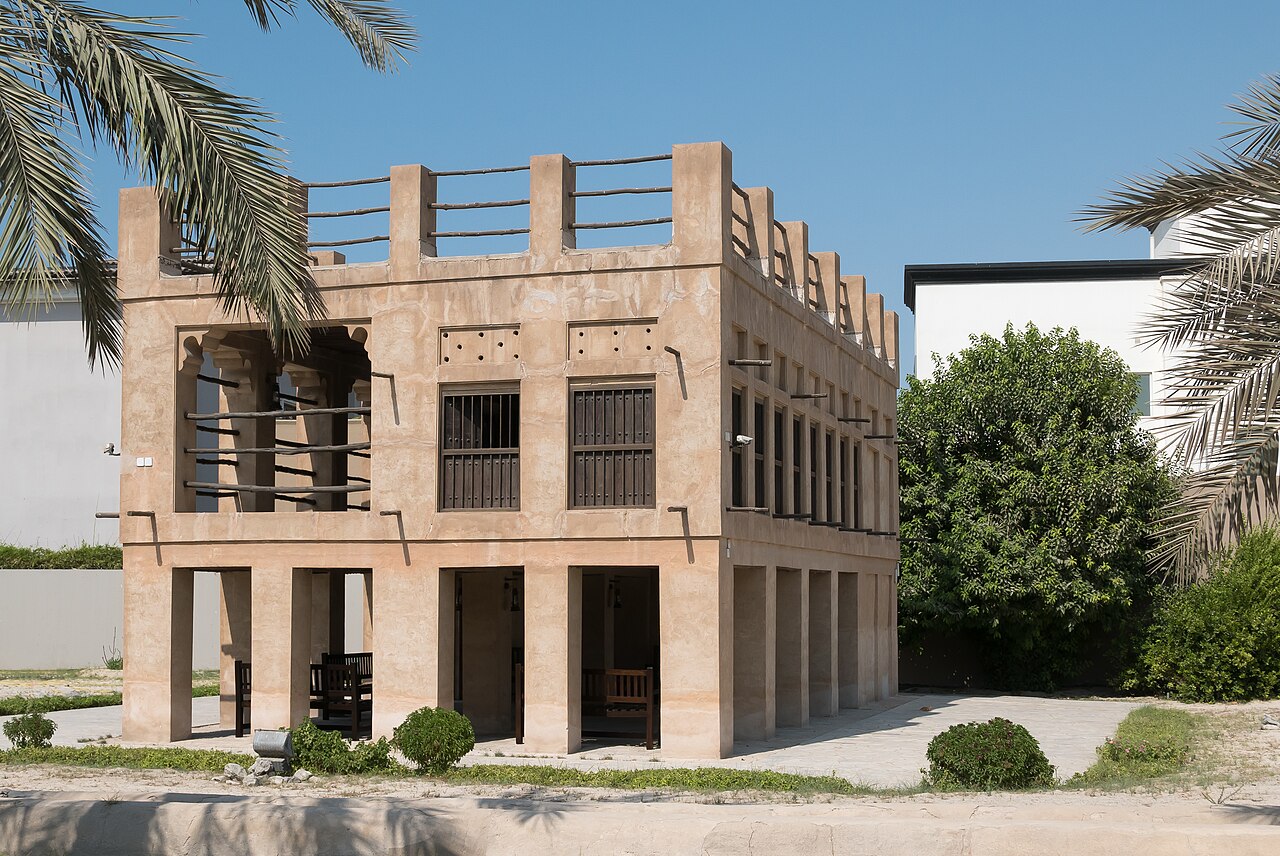
Choose the Museum of the Poet Al Oqaili for manuscripts, a courtyard house and a morning in Deira. Choose Majlis Ghorfat Umm Al Sheif for a former summer retreat in Jumeirah, where the furnishings bring the business of receiving guests into focus. Both reward a visit built around a particular person and place.
The opening window should decide the day. When checked on 8 November 2026, Al Oqaili’s attraction page listed Friday, 8am–11:30am; the majlis listed Monday–Friday, 7:30am–3:30pm, closed Saturday and Sunday. Al Oqaili’s other weekday access needs confirmation because an older government timetable differs. Call Dubai Culture on 800 33222 before making either house the reason for a journey across town. Al Oqaili visitor listing · Umm Al Sheif visitor listing
| Choose by | Museum of the Poet Al Oqaili | Majlis Ghorfat Umm Al Sheif |
|---|---|---|
| Main interest | A poet’s writing, correspondence and domestic setting | A ruler’s retreat, reception room and household objects |
| Area | Al Ras, Deira, beside the Spice Souk | Jumeirah |
| Published visiting window | Friday 8am–11:30am; ask about other weekdays | Monday–Friday 7:30am–3:30pm; weekends closed |
| Admission position | Services directory lists free entry; current attraction page gives no price | Current attraction page gives no fee or booking terms |
| Natural follow-on | Stay around the Deira souks and Creek | Keep the rest of the outing in Jumeirah |
The table records the published listings, not a reservation or a guarantee that every room will be accessible. Confirm admission, the day’s interior access and any assistance your group needs together.
Al Oqaili and the writing within the house
Mubarak Al Oqaili’s museum occupies a house built in 1923 in the narrow lanes near the Spice Souk. Dubai Culture describes builders brought from Al Ahsa, two floors arranged around an internal courtyard, and ornament and inscriptions that give the building its character. This is a useful place to see how a domestic setting and a collection can explain each other: the rooms provide a setting for the papers, while the papers give a person to the rooms. Dubai Culture’s online exhibition
Start with one piece of writing rather than trying to take in every case at once. The collection covers classical and Nabati poetry, correspondence, manuscripts and the poet’s cultural and social life. Original work in his handwriting sits alongside belongings and household furniture. A letter offers a different question from a poem: who was the recipient, and what does the exchange reveal about the writer’s relationships? The museum’s nine sections give you several ways to follow that question without needing to be a poetry specialist.
If you read Arabic, the distinction between classical and Nabati verse gives the visit an obvious thread. If you do not, begin with the documents as objects: handwriting, page layout and the way material is presented alongside a person’s possessions. Ask about interpretation in your preferred language before visiting if understanding the texts is central to your interest.
Then return to the building. The Ministry of Culture’s museum guide identifies decorative wooden doors, palm materials in the ceilings and the inner courtyard among its architectural features. Its photograph of the approach shows why it is worth using the museum’s exact location: the entrance belongs to a narrow lane, rather than a large forecourt. Keep the location page available on your phone before entering the souk area. Ministry of Culture museum guide, page 45
Look at how the rooms relate to the courtyard and how the doors frame the movement between them. The museum includes material about restoration, so the distinction between the surviving house and later conservation is itself part of the visit. The construction date describes the house; it does not date every furnishing, repair or display now inside it.
Protect the Friday morning window
The current attraction page’s 8am–11:30am Friday listing is unusually narrow. It does not say that 11:30am is a last-admission time, so do not plan to arrive at the end of that window. Make the house the first planned stop, then leave the souk browsing flexible. If the visit matters more than the rest of the outing, confirm that the museum will admit visitors on your intended date before setting off.
There is a reason to be specific when asking about another weekday. Dubai Culture’s government announcement of 28 December 2021, effective from January 2022, gave the specialised museums additional Monday–Thursday hours. The present Al Oqaili attraction page shows Friday only. The older announcement does not establish that those other sessions still operate, and a missing weekday on the current page does not prove a permanent closure. Ask for the museum’s current visitor timetable rather than relying on general authority office hours. Dated government announcement
Dubai Culture’s services directory lists Al Oqaili admission as free for all visitor categories. Treat that as a published directory entry to confirm, since the attraction page does not repeat a price. The same directory describes guided visits subject to request and availability, with advance arrangements for groups. It is not a promise that a guide will be waiting for an individual walk-in. Ask about a tour separately from entry, especially if you need language support or are bringing a group. Museum services directory, pages 36–43
Afterwards, staying around the Spice Souk and Creek keeps the morning simple. You have already protected the activity with the more restrictive hours. The rest can expand or contract around your interest, the weather and the group’s energy. There is little benefit in committing to a distant lunch reservation before you know how long you want with the collection.
Umm Al Sheif and the art of receiving guests
Majlis Ghorfat Umm Al Sheif was established in 1955 as Sheikh Rashid bin Saeed Al Maktoum’s summer retreat in Jumeirah. Dubai Culture describes a setting used both for quiet time and for discussions with advisers. Bring that purpose into the visit: this was a place where receiving people and considering decisions shared the same domestic surroundings. Dubai Culture heritage listing
The collection makes that purpose tangible. Coffee equipment, rugs, vessels, clocks and radios provide several scales of detail to notice. Begin with the room’s arrangement, then choose an object that would have had a practical role. A clock suggests the organisation of a day; a coffee implement suggests preparation and service. Looking at both helps avoid treating the majlis as simply a room of old furniture.
For children, a small observation game works better than asking them to absorb a long chronology. Choose an object they recognise and another they cannot immediately identify, then use the labels or ask a member of staff about their functions. Keep this to looking and asking: a displayed household object is not necessarily a handling exhibit, and the published description does not promise an interactive children’s activity.
The building also has a story beyond the reception room. Dubai Culture’s online exhibition describes two storeys, a palm garden, a well and irrigation channels, alongside the traditional materials used in construction. The authority connects the name Umm Al Sheif with a pearl fishery. These details give you another thread to follow: how the retreat related to water, planting and the coastal world around it. Dubai Culture’s Umm Al Sheif exhibition
That exhibition uses historical and museum photography; it is useful for understanding the site, but it does not confirm which outdoor or upstairs areas are open on a particular day. Ask specifically about those spaces if they are your main reason for visiting. A two-storey historic building also warrants an access check for anyone who cannot comfortably manage stairs.
Choose a weekday and keep the afternoon local
The current listing gives 7:30am–3:30pm, Monday to Friday, with Saturday and Sunday closed. The page supplies no admission price, booking procedure or separate last-entry time. Check all three if you are making a special journey, and confirm Friday access rather than assuming every government-operated attraction follows the same Friday arrangement.
A morning visit leaves room for lunch elsewhere in Jumeirah without depending on arrival close to closing time. Keep lunch flexible until access is confirmed.
If your main interest is architecture, use the whole setting rather than concentrating only on a photograph of the reception room. If your interest is political or social history, begin with the building’s role as a place for conversation and decision-making. Either approach gives a modest-sized site a clear purpose without promising the scale of a major museum.
Choosing one house or visiting both
For a single morning, choose one house and stay in its area. Al Oqaili is the stronger fit for readers, manuscript enthusiasts and people already planning Deira. Umm Al Sheif suits someone who wants a focused visit to a former retreat in Jumeirah, with furniture and domestic routines as the starting point.
A Friday combination is possible to investigate, but it should remain conditional on both sites confirming access. Start with Al Oqaili because its published window ends earlier. Then allow for the journey to Jumeirah and the second venue’s actual admission arrangements. There is no verified journey time or combined ticket on which to build a rigid two-house schedule.
For a Saturday or Sunday, choose another outing with confirmed weekend access. Umm Al Sheif explicitly lists both days as closed; Al Oqaili’s current page does not establish a weekend visit.
Before travelling, ask Dubai Culture for the exact house, date, interior access, admission terms and any language or mobility assistance you need. The contact shown on both attraction pages is 800 33222, with info@dubaiculture.ae as the published email.
Cover photograph: Majlis Ghorfat Umm Al Sheif, 2018, by Celia Brock, used under CC BY-SA 4.0. Displayed from Wikimedia’s resized version; the photograph retains that licence.


Comments (0)
No comments yet. Be the first!