
A length of embroidered fabric, a small packet of spice and a bottle of fragrance lead to three very different conversations in old Dubai. That is the pleasure of the Creek’s markets: the goods give you a reason to look more closely. You can spend a visit comparing jewellery designs, asking how an unfamiliar ingredient is used, or choosing cloth for something you actually want to make.
Choose your souk by that interest first. The Gold, Spice and Perfume souks are on the Deira side of the Creek. The Textile Souk is across the water in Bur Dubai. They combine beautifully, but their shops do not all follow one timetable. In particular, Visit Dubai currently lists the Textile Souk as closed on Fridays and describes a daytime Friday closure at the Spice Souk. Saturday to Thursday is the more straightforward choice for a visit built around both.
This guide concentrates on those four traditional markets. Give yourself permission to explore one properly: a small purchase with a story behind it can be more satisfying than rushing through every lane.
Choose your market
| What interests you? | Start here | The practical distinction |
|---|---|---|
| Jewellery design, gold and elaborate shop windows | Gold Souk, Deira | Most shops are listed as opening 10am–10pm, with individual variation |
| Cooking ingredients, teas and small purchases by weight | Spice Souk, Deira | Shop hours vary; avoid relying on daytime Friday trading |
| Arabian fragrances, oud, bakhoor and personalised scent | Perfume Souk, Deira | Visit a particular shop for its products; no single verified market-wide timetable |
| Cloth, embroidery, trims and ideas for a garment | Textile Souk, Bur Dubai | Published hours are 9am–8pm, Saturday–Thursday; some vendors break 2pm–4pm |
Opening details were checked on 9 November 2026. These are the tourism authority’s published patterns; a particular trader can keep different hours. If your visit depends on one shop, check that shop before travelling.
1. Gold Souk: for jewellery as an object of design
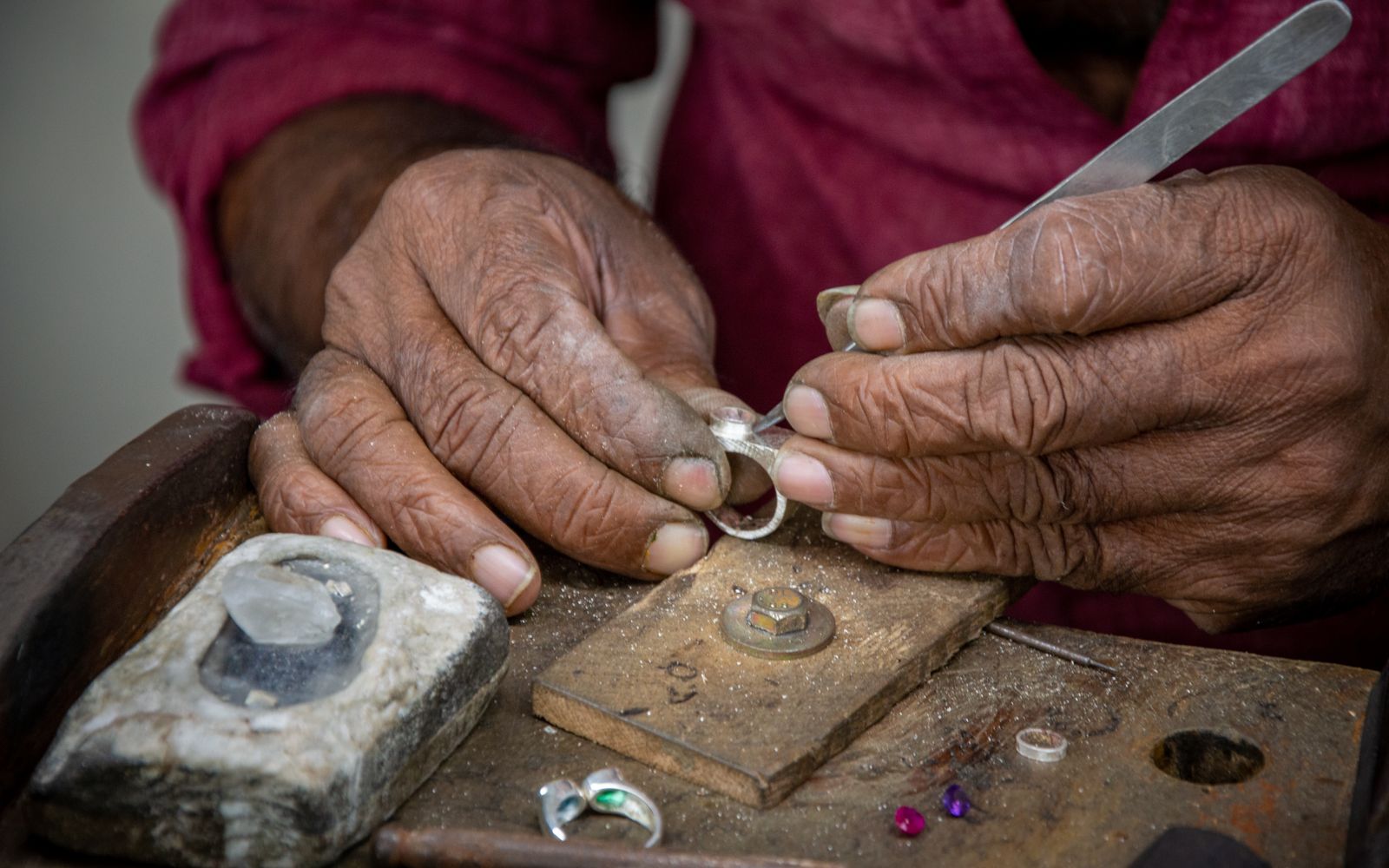
The Gold Souk is a natural first choice if you enjoy looking closely at how things are made. Its appeal extends beyond the price of the metal. Look at the scale of a necklace, the repetition within a bracelet, or the way a shop brings several pieces together into a set. Comparing those decisions makes the windows interesting even when you have no intention of buying.
Visit Dubai identifies jewellery in different gold carats alongside diamonds, pearls, platinum and silver. That range matters: two pieces that catch your eye may have quite different materials and specifications. A memorable design is a starting point for a conversation, rather than enough information to compare the final price.
If you are shopping, ask the seller to explain the particular piece and its full quoted cost. Establish what is included in the quote, what documentation accompanies the purchase and what the shop’s return or alteration terms are before agreeing. Those are questions for that trader and item. A general description of the souk cannot establish the terms of every transaction.
You can also enjoy this market without turning the visit into a shopping assignment. Choose a handful of windows, compare the designs and move on when you have had enough. Admission to visit the souk is free, according to Visit Dubai; purchases are separate. There is no need to buy jewellery to make this a worthwhile stop.
Plan your visit: the souk is in Deira. Visit Dubai names Al Ras and Gold Souq stations on the Metro’s Green Line as approaches and lists most shops as opening from 10am to 10pm. Treat that as a broad trading window, rather than an assurance that every shutter will be up at either end of the day.
Pair it with: the Spice Souk if you want a complete change in what you are looking at, or the Perfume Souk if you prefer another visit centred on choosing a personal object. Staying on the Deira side keeps this combination simple.

2. Spice Souk: for the ingredient you will actually use at home
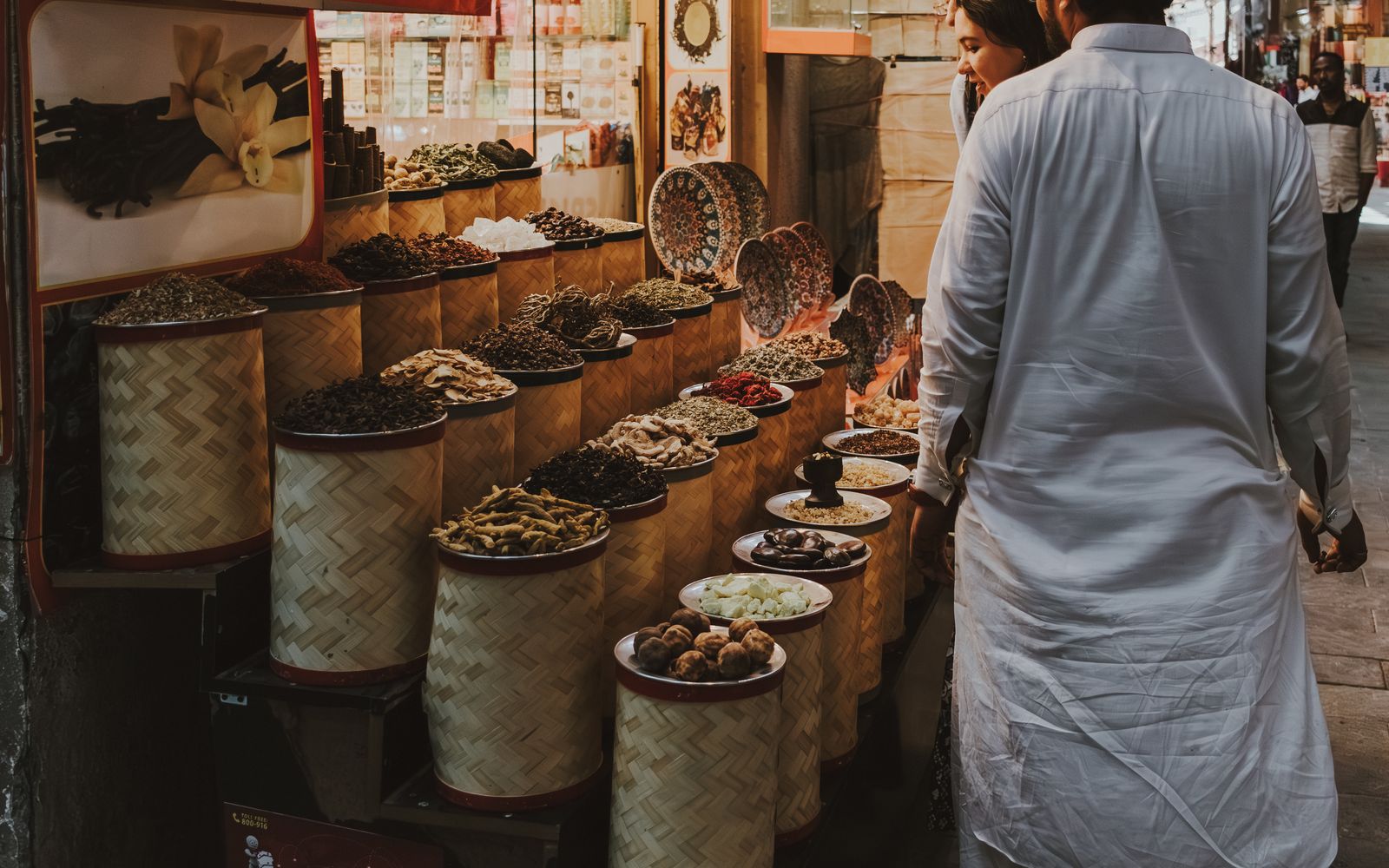
The most rewarding approach to the Spice Souk is to arrive with a little curiosity about cooking. Perhaps you want a spice for a dish you already make, a tea you have not tried, or a small gift for someone who enjoys experimenting in the kitchen. That gives the displays a purpose beyond being a colourful backdrop.
Visit Dubai describes ingredients associated with Arabic and subcontinental cooking, as well as teas, nuts, oils and saffron. Goods are sold by weight and in packets. That creates a useful choice: a small quantity can be enough for a first experiment, while a prepared packet may be easier to carry or give away.
Ask what the ingredient is called and how the seller suggests using it. For a blend, ask about its ingredients and intended dish. If you have allergies, dietary restrictions or a particular product requirement, establish those details before purchasing. A loosely described blend is not enough information to assume it suits you.
The quantity deserves as much attention as the headline quote. Make sure you and the seller are discussing the same weight or packet size, then establish the total before the goods are packed.
The experience suits visitors who enjoy asking questions. You might leave with only one ingredient, but with a clearer idea of how to use it. That is a stronger souvenir than buying a large assortment you cannot identify once you get home.
Plan your visit: Visit Dubai locates the market at 26 34 Street, Al Ras, Deira. Its expanded opening information describes varied daily trading, often beginning before 8am and continuing after 9pm, with a daytime Friday closure. There is no verified single Friday reopening time in that information. Build a cooking-focused visit on another day rather than assuming all stalls will reopen together at a particular hour.
Pair it with: Gold for a short Deira combination, or Bur Dubai’s Textile Souk for a visit that follows two very different kinds of merchandise across the Creek. For the latter, choose Saturday–Thursday and allow for the textile vendors’ possible afternoon break.
A view from the lanes: Wander With Nada’s Spice Souk group photograph gives a glimpse of the Deira setting, shared by the local guide in September 2026.
3. Perfume Souk: for a scent with a more personal brief
The Perfume Souk rewards a different pace. Here it helps to know something about the person you are buying for: do they want a fragrance to wear, or something to scent a room? Are they drawn to a familiar style, or interested in exploring Arabian perfumery? A clear brief gives the seller somewhere useful to begin.
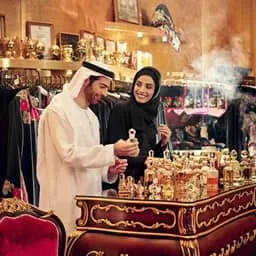
Visit Dubai places the market on Sikkat Al Khali in Deira and describes Arabian scents, oud, bakhoor and opportunities for custom blends. The distinction between products is central to choosing well. A wearable fragrance and a product intended for home fragrance serve different purposes; ask the seller to explain the intended use and any equipment needed for the exact item you are considering.
For a personalised blend, explain your preferences before concentrating on the bottle. Ask about the finished quantity, the total price and what the shop records about the blend if you hope to buy it again. These details make a personalised purchase useful beyond the first day. They are shop-specific questions, not standard inclusions that every seller is obliged to provide.
This is also a good stop for someone who wants a focused souvenir rather than another bag of assorted gifts. Give yourself time to consider the options. If you are choosing for someone else, a clear description of the product and how it is used will help them enjoy it when they receive it.
The market belongs naturally with the other Deira souks, but it has its own reason to visit. Jewellery is a visual decision; ingredients invite a conversation about cooking; fragrance asks you to articulate a preference that can be harder to put into words. That variety is what makes a two-market visit feel substantial.
Plan your visit: use Sikkat Al Khali, Deira, as the location reference. The reviewed Visit Dubai page does not provide one current opening timetable for the whole Perfume Souk. Do not apply the Gold Souk’s 10am–10pm pattern to it automatically. If a particular perfumer is the main reason for your journey, confirm that shop’s hours.
Pair it with: Gold for jewellery and fragrance shopping, or Spice if your interest is in how merchants explain and prepare their products. Both keep you on the Deira side of the water.
4. Textile Souk: for fabric, finishing details and the beginnings of a garment
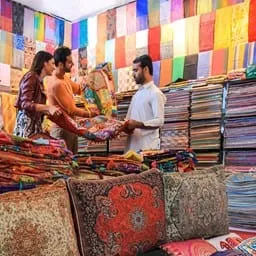
Across the Creek, Bur Dubai’s Textile Souk shifts the attention to cloth. Visit Dubai lists raw silk, cotton and embroidered fabrics, with buttons, sequins, stones and lace among the finishing details. There are ready-to-wear options and nearby tailors too. You can browse for something complete, or begin with the material and imagine what it might become.
This is the best fit for someone who enjoys colour and detail at close range. Look at a fabric as more than a folded display: ask to see enough of it to understand the pattern, the weight and how it falls. A trim might be the most interesting purchase if you already sew or want to change a garment you own.
For a specific project, arrive with useful information. Bring the measurements or fabric requirements you have been given, and make clear whether you are discussing cloth alone or a finished item. Establish the quoted unit and total quantity. If you want tailoring, agree the garment, work included, fittings, completion date and collection arrangements with the individual tailor.
The existence of nearby tailoring does not establish a same-day service. Avoid building the visit around collecting a finished outfit before a flight unless a particular business has accepted that schedule. The more satisfying plan is to choose an item or project that fits the time you actually have.
The Textile Souk also makes the strongest argument for crossing the Creek during a market visit. It is a distinct destination on the Bur Dubai bank. Use the shore and street location when arranging where to meet someone.
Plan your visit: Visit Dubai gives the address as 57 Ali Bin Abi Talib Street, Bur Dubai, and names Sharaf DG and Al Ghubaiba stations on the Green Line as approaches. Its current body text and opening-hours answer list 9am–8pm on six days, with Friday closed. Some vendors may take a 2pm–4pm lunch break. For a visit centred on cloth shopping, a Saturday–Thursday morning is a useful choice.
Pair it with: Spice for a visit built around ingredients and materials, or Gold for the greatest contrast between displays. Both pairings require crossing to Deira; keep that transition in your plan rather than treating the four markets as one uninterrupted lane.
Visit Dubai’s illustrated Textile Souk page shows the fabric-shopping setting and gives the published visitor information.
Why these markets still make a compelling cultural visit
The interest lies in what people are selling and discussing today. A market visit lets you follow a particular object from display to explanation: what it is, how it is used, what quantity you need, and why one version differs from another. You can appreciate that exchange without making a large purchase.
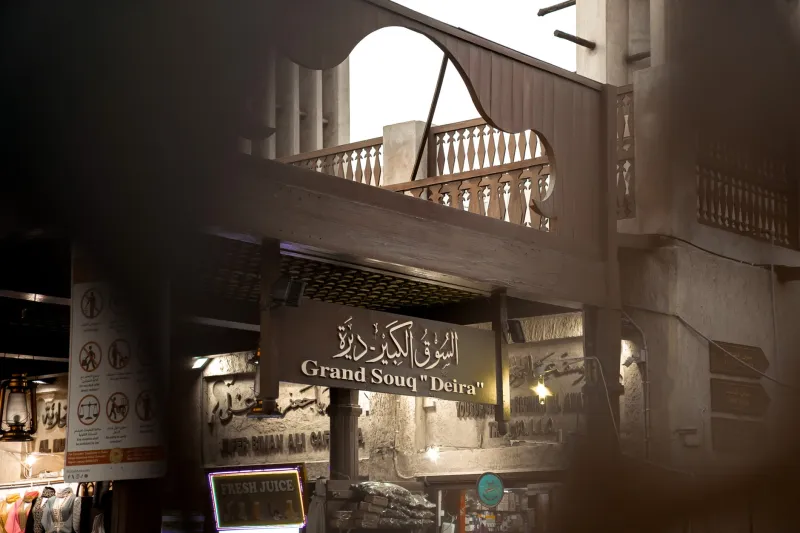
The public spaces are evolving too. In an announcement dated 24 August 2025, Dubai Municipality reported completing three heritage tourist trails in Deira’s markets: the Gold, Al Ahmadiya and Spice axes. The work included improvements such as shading, signage, floor markings, façade lighting and public squares. The announcement describes a wider trading area encompassing perfume, carpets, textiles, household goods and other merchandise alongside gold and spices.
That is useful context for exploring Deira, rather than a reason to treat every market as identical. The pleasure of the walk is in noticing the changes between streets and trades while keeping the particular market you want to visit in mind.
Build a visit around two interests
For a first look at Deira, choose Gold and Spice. The contrast is immediate: jewellery designs give way to ingredients sold in small quantities. You can keep the visit on one shore and decide whether fragrance shopping deserves another stop. Check the day before relying on Spice Souk trading.
For making and cooking, choose Textile and Spice. Start with the market that matters most to you. A Saturday–Thursday morning works particularly well for the textile side because it avoids the published Friday closure and the possible afternoon lunch break. Cross the Creek for the second part rather than adding more markets simply to complete a list.
For a personal gift, choose Gold and Perfume. Establish a budget and the recipient’s preferences before shopping. Jewellery specifications and fragrance quantity are different decisions; a beautiful display does not remove the need to understand the exact item and final quote.
The traditional public abra can connect the two shores. RTA lists CR1 between Bur Dubai and Deira Old Souq at AED1 in cash per passenger, per trip. Use those station names when choosing the crossing. Other abra routes use different station pairs and can have different fares; a private sightseeing hire is another product altogether. Keep cash for the crossing and check the current RTA route information before travelling.
RTA’s abra photographs on Instagram offer a wider look at the boats.
Small choices that make the visit better
Ask before photographing a person or the inside of a shop, and leave room for customers and deliveries when you stop. These are working retail spaces. A little patience makes it easier to look closely without getting in the way.
For purchases, agree the product, quantity and complete price before paying. Keep the receipt and any product details the seller provides. For fabrics, fragrances and blends, a clear description is particularly useful when the item looks different once it is away from the display.
Most of all, let your own interest decide when to stop. Someone who loves textiles may find more in one fabric discussion than in three additional markets. Someone curious about cooking may prefer a small packet and a useful explanation to a bag full of gifts. The Creek’s souks offer enough variety to make a personal visit; you do not need to collect every name on the map.
Comments (0)
No comments yet. Be the first!