

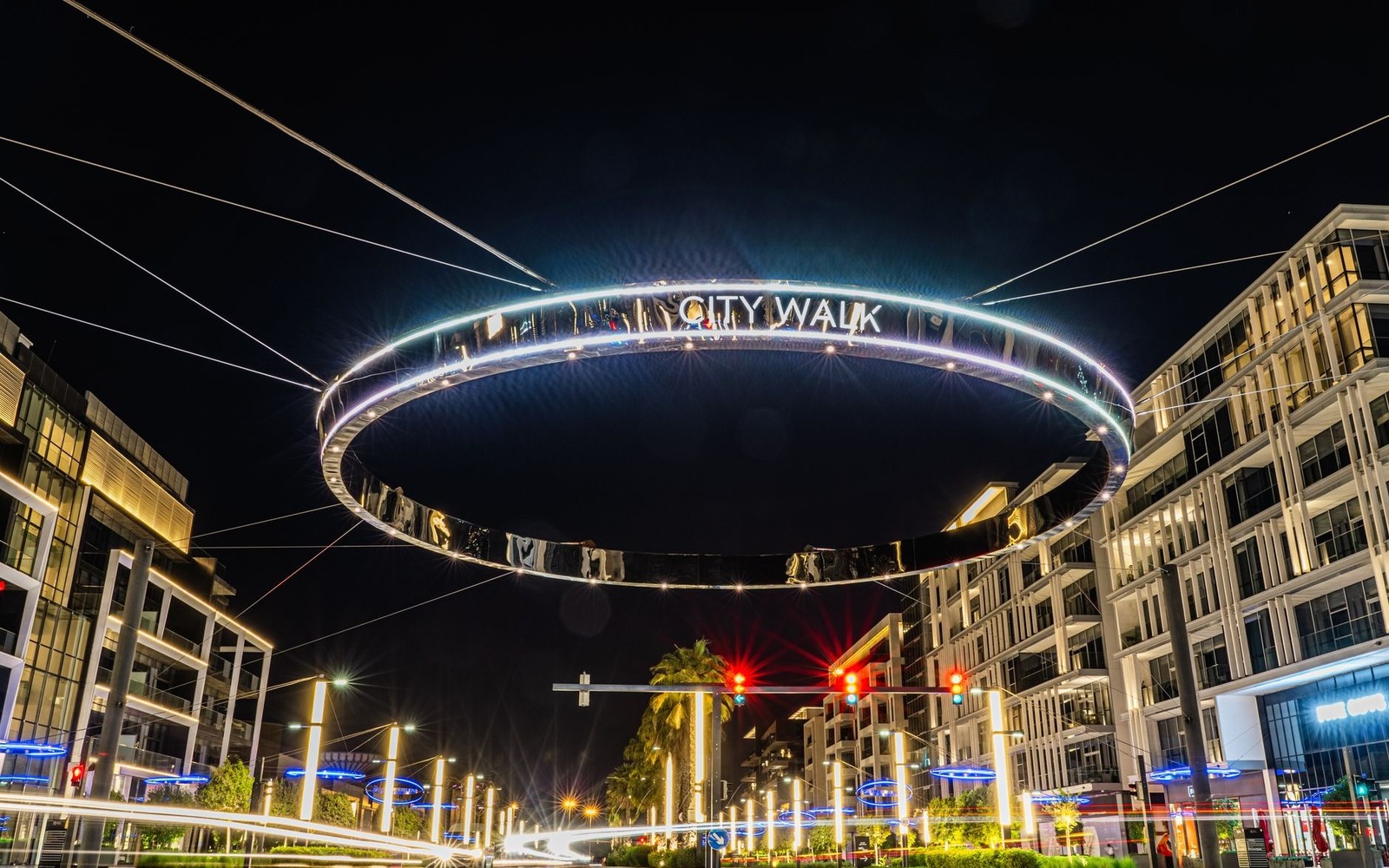
For a first City Walk art outing, choose three different kinds of work: Beau Stanton’s changing image, Vhils’s carved portrait and Eelus’s coloured rain. That gives you an optical effect, a physical surface and a bold painted composition within one destination. If portraits are your main interest, replace Eelus with Rone’s Nadila or Etam Cru’s Girl with the Orange.
City Walk’s Art Walls guide still lists all eight entries below. Open its photographs before you arrive: they are more useful for recognising individual walls than a generic City Walk map pin. The collection is spread around the district, and the selection here groups works by interest rather than prescribing a walking order.
Checked 8 November 2026. A current operator listing establishes what City Walk promotes; it cannot guarantee that every approach will be clear on your visit. Ask at the customer-service desk beside FiLLi Select for the easiest route to your chosen works. Three well-chosen stops make a better short outing than spending the whole visit searching for a particular façade.
Choose your first three works
| Your interest | Start with | Add a contrasting work |
|---|---|---|
| A picture that changes with movement | Beau Stanton | Vhils for an image made by cutting the surface |
| Faces and portraiture | Rone and Etam Cru | The London Police for stylised characters |
| Lettering and architectural scale | eL Seed | Eelus for a simple figure and strong colour |
| Stencils and visual storytelling | ICY and SOT | Stanton for a different use of the building |
Choose daylight if recognising the details is the main purpose. A late afternoon visit can leave room for food afterwards, but make the meal a separate reservation if you have a particular restaurant in mind. Avoid attaching a fixed completion time to all eight murals: finding the right side of a building, pausing for photographs and accommodating the group will affect the walk.
Vhils and a portrait cut into the wall
The portrait associated with Bedouin and Scratching the Surface looks quite different from a smooth painted face. In the destination’s photographs, pale wall material separates rough darker marks, with the headcloth, eyes and beard becoming clearer when seen together. This is the stop for someone interested in the making of an artwork as much as the finished image.
Vhils’s own Dubai Walls record places the commission at City Walk in Al Wasl in 2016. He excavated the façade, drawing on early photographs of the region’s Bedouin communities. The historical reference connects the portrait to lives preceding the surrounding urban development. It also explains why the building’s material matters: removing part of the surface is the technique, rather than a sign that paint has simply worn away.
Begin far enough back to see the face, then compare the texture from a closer public viewpoint. Keep your hands off the surface. The useful contrast with Rone is how the portrait is formed: one is cut into the wall, while the other is painted across it.
Beau Stanton and the changing viewpoint
Stanton’s 2016 mural archive names its Dubai work Lenticular. The artist’s photographs show a sailing ship above a series of deep vertical sections, with red and turquoise rays across the upper part. An oblique view brings a large classical-looking face into focus below the ship.
That gives you a clear way to recognise the work and try its effect. Move along the available pedestrian space and watch how the narrow surfaces combine into a different reading. The structure stays still; your position changes which painted sections you see. A straight-on photograph and an angled photograph can therefore look surprisingly different.
This is a strong choice for a mixed group because the change is immediate. Let someone find the face while another person starts with the ship, then swap viewing positions. Keep enough space for passers-by rather than backing into a road or standing in a doorway to obtain a particular angle.
eL Seed and the exterior of The Green Planet
For a recognisable building as well as a mural, find eL Seed’s silver-toned calligraphy on The Green Planet’s exterior. City Walk identifies the text with the poem Positive Spirit. Its photographs show looping forms covering a tall pale surface, with the building’s shape and openings still visible through the composition.
The artist describes his practice through painting, sculpture and calligraphy, drawing on writers and communities associated with the places where he works. Here, you can approach the wall through the text or through the way the strokes fill the building. You do not have to read Arabic to notice the density of the lines and the gaps between them; reading the script brings a different layer of understanding.
Treat this as an exterior art stop. Going inside the rainforest attraction is a separate decision with its own admission arrangements. If the mural is the only reason for visiting this part of City Walk, ask for the public approach to that wall before joining an attraction queue.
Rone and the portrait of Nadila
Nadila is a painted portrait by the Australian artist Rone, also known as Tyrone Wright. City Walk connects it to his earlier portrait of a woman in Havana. The destination’s reference photograph shows a large face on a pale, weathered-looking wall, with dark hair across the lower part and marks continuing around the image.
Choose it if you prefer a face you can return to over a sequence of small graphic details. Its surface treatment also makes a useful comparison with Vhils: look at what seems to be represented in paint and what is physically removed from a wall. Use the reference photograph to identify the work rather than assuming every large female portrait in the area is by the same artist.
For a comparison with his indoor work, Rone’s HOME post shows a pale portrait across the wall of a furnished domestic interior. Published on 12 July 2026 in Dubai time, it promoted an open-edition print. That image is a separate artwork, not Nadila or a room at City Walk. The contrast is how a face relates to the space around it.
Eelus and the coloured rain
Look for Not Everything Is So Black & White by Eelus. The reference images show a monochrome figure holding an umbrella beneath long bands of bright colour. The grey wall and dark silhouette make those narrow coloured lines easy to pick out.
This is one of the easiest works to describe to a companion who has wandered ahead: the umbrella and coloured rain are more distinctive directions than “the colourful wall”. It also gives children a concrete feature to find without requiring them to understand a long artist biography.
Stand where you can see the upper part as well as the figure. A tightly cropped photograph of the person alone loses the relationship between the umbrella and the lines above it. Choose this over another portrait if you want your short selection to include a different visual idea.
ICY and SOT and the birds around a face
City Walk lists Let Her Be Free by ICY and SOT across facing walls. The reference photographs show faces surrounded by clusters of small dark birds; the overall mass changes as you begin to distinguish the individual shapes. Look at both walls rather than stopping at the first face you recognise.
The brothers now present their work as Saman and Sasan Oskouei. Their current studio biography explains that they began making stencil-based street art in Tabriz under the name Icy & Sot, before moving into a wider practice including sculpture and installation. This helps connect the credit on City Walk’s older commission to the artists’ current website.
The facing arrangement is the feature to plan around. Leave the passage open while comparing the images, and avoid treating the space between the walls as a private photo studio. With limited time, this is a good alternative to a single portrait because the relationship between two surfaces becomes part of the stop.
Etam Cru and Girl with the Orange
Etam Cru is the duo Bezt and Sainer. City Walk places Girl with the Orange on a building at the edge of its pedestrian complex. The photographs show a seated figure with a lowered head and pale draped clothing against a dark background; the small orange provides a contrasting point of colour.
The composition is quieter than the London Police characters or Stanton’s ship. Choose it when your group wants a figurative work and is happy to seek out a perimeter wall. Save its reference image before moving away from the central pedestrian area, and ask for the public approach if the building side is not obvious.
Pairing it with Nadila gives you two different treatments of a person: a large face that dominates its wall and a seated figure within a darker scene. There is little benefit in adding both to a rushed visit simply to increase the number of stops.
The London Police and the LADs characters
The London Police’s wall is recognisable by round smiling faces, thick black outlines and densely packed drawn structures. The operator’s photographs show the characters across a long surface with pale and bright green areas. It works particularly well as a contrast to the textured portraits.
The artists’ own introduction identifies Chaz Barrisson and Bob Gibson and describes their combination of Chaz’s LAD characters with Bob’s architectural and portrait drawing. They emphasise drawing by hand, a useful detail when looking at the regular outlines and tightly organised forms.
City Walk gives a pedestrian-zone entrance as the broad location cue. Show the picture when asking for directions; there are several ways into the district. Once you find it, let the group pick out a character or small structure before moving on. You can enjoy a short encounter here without treating every detail as something that needs an explanation.
Getting there and choosing the parking area
City Walk is at the Al Wasl and Al Safa Road junction. Its arrival page directs Metro users to Burj Khalifa/Dubai Mall on the Red Line. Plan the final connection to City Walk separately; the station is not an entrance beside the murals. For driving, use the actual destination and parking signs rather than a mural photograph as your navigation point.
The published parking information distinguishes two arrangements:
- General visitor parking: first hour free, then AED5 for each additional hour. The operator lists validation through selected outlets and attractions.
- The Boulevard: first 30 minutes free, then AED20 per additional hour through Salik. A qualifying spend of at least AED50 at participating outlets can validate the first three hours.
Confirm the zone and validation conditions before leaving the car. A mural walk does not itself qualify as a purchase, and a receipt from any shop is not automatically a valid parking discount. If you already intend to eat or shop, ask that outlet about validation before paying. Do not spend AED50 solely on the assumption that it will reduce a smaller parking bill.
For a late visit, check your chosen business directly. The FAQ’s closing times are one hour earlier than the website footer’s, so the site does not provide one consistent set of destination hours. Those retail and restaurant listings also do not establish unrestricted access to every wall. The customer helpline is +971 4 590 5090.
Water stops and practical access
Bring a refillable bottle. City Walk places its free Dubai Can water station opposite FiLLi Select, close to the customer-service landmark. The operator’s station page provides that location, while its 24 September Instagram photograph shows the orange-and-silver dispenser in use. Neither establishes a separate round-the-clock operating schedule, so arrive with water rather than depending on a single refill point.
The services page lists accessible toilets and limited numbers of wheelchairs and strollers. If a level route or equipment loan determines whether the outing is practical, contact the desk before travelling and name the particular walls you want to see. A general amenities list does not describe every kerb, crossing or temporary obstruction along an eight-stop walk.
For photographs, keep the difference between a casual visit and a planned production clear. City Walk requires its marketing department’s approval for professional photoshoots; ask customer service before bringing a commercial shoot. Its courtesy policy also asks for respectful clothing and prohibits pets, skateboarding, hoverboarding and rollerblading.
Start with your three priorities, keep their reference images available and decide on extra stops once everyone is comfortable. That leaves room for the particular pleasure of this collection: seeing how differently artists use the same basic canvas of a city wall.
Comments (0)
No comments yet. Be the first!