

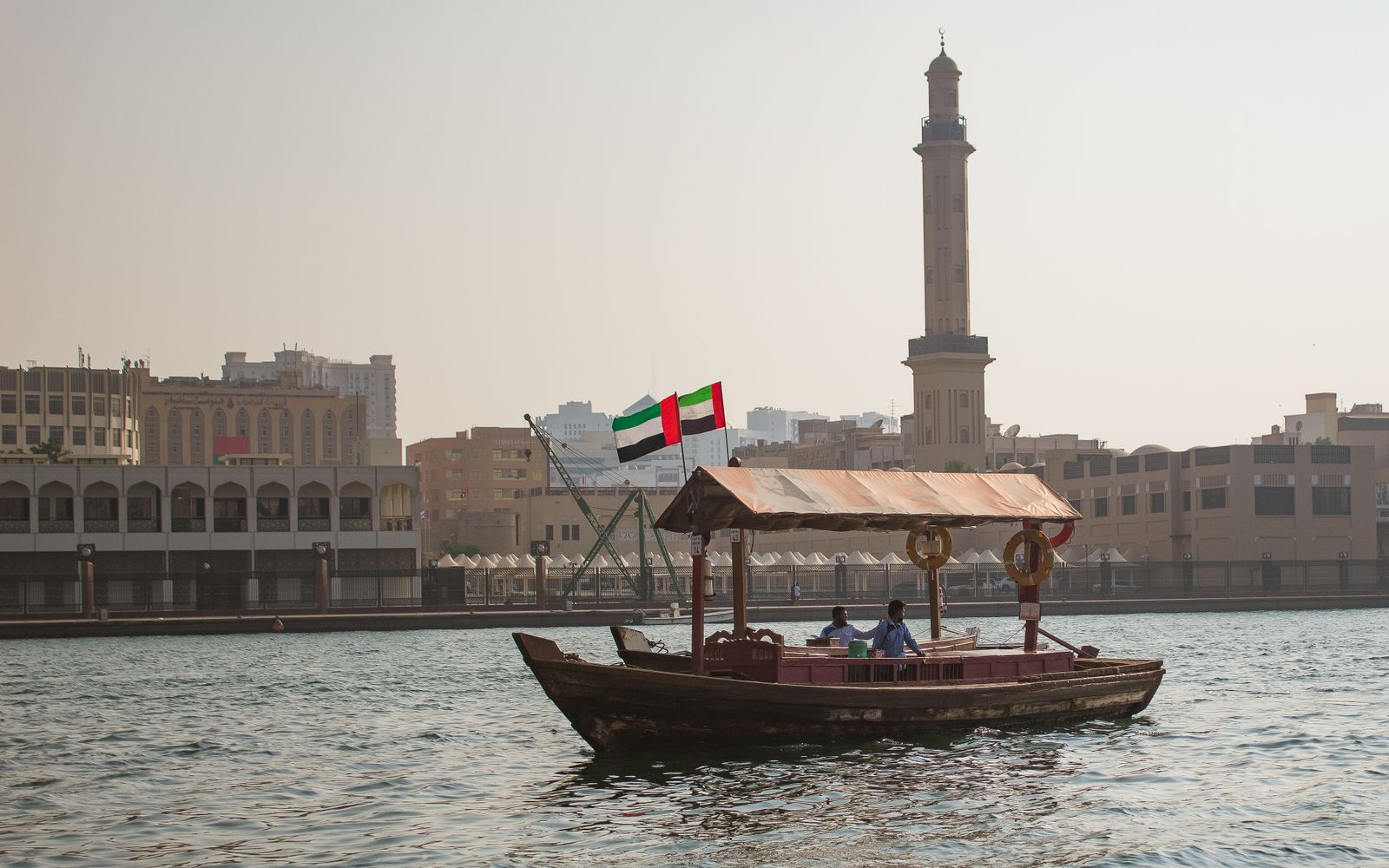
Choose an abra by the station where you want to arrive. For a traditional crossing between the souk areas, start with CR1 or CR2 and bring cash. For a visit beginning around Al Fahidi or Al Seef, check the corresponding AED 2 route and its direction-specific timetable. Private hire is a separate choice for time on the water, with a price for the boat and duration rather than an ordinary passenger crossing.
The names are easy to mix up: Bur Dubai Abra Station and Dubai Old Souq Station are separate boarding points, while Deira Old Souq, Al Sabkha and Baniyas are different arrivals. Saving the correct pair matters more than saving one dirham. The routes, fares and service information below were checked on 8 November 2026.
Match the route to the two shores
RTA’s traditional-route page and Creek service information list these public crossings. Read the pair in either direction, then check departures from the station where you will actually board.
| Route | Bur Dubai bank | Deira bank | Ordinary fare per passenger per trip |
|---|---|---|---|
| CR1 | Bur Dubai Abra Station | Deira Old Souq | AED 1, cash only |
| CR2 | Dubai Old Souq | Al Sabkha | AED 1, cash only |
| CR3 | Dubai Old Souq | Baniyas | AED 2 |
| CR4 | Al Fahidi | Al Sabkha | AED 2 |
| CR5 | Al Fahidi | Deira Old Souq | AED 2 |
| CR6 | Al Seef | Baniyas | AED 2 |
CR7 is different: it connects Al Seef, Al Fahidi and Dubai Old Souq along the Bur Dubai side. RTA’s dedicated Creek page marks it temporarily on hold until further notice. Its code still appears in the general route list, which does not establish that it has resumed. Keep it out of your plan unless RTA confirms otherwise.
Use CR1 or CR2 for a souk-focused crossing
Visit Dubai’s abra guide places Deira Old Souq near the Spice Souk and Bur Dubai Abra Station west of the Textile Souk. CR1 therefore gives you a clear pairing for a visit built around textiles on one bank and spices on the other. You can browse first, cross when ready and continue from the named arrival station.
CR2 takes you between Dubai Old Souq and Al Sabkha, which the same destination guide places southwest of Baniyas Square. That is a useful alternative when your next meeting point, shop or onward journey is on that side of Deira. It should not be chosen simply because someone described it as the boat to the “old souk”. Keep both station names in your directions.
The traditional page lists CR1 from 6am to midnight and CR2 as a 24-hour service. RTA’s general timetable describes both as on demand. Those statements identify the service window and operating format; they do not promise an empty boat waiting for your party or a departure at a fixed minute.
Bring small cash for these two routes. For two fare-paying adults, one crossing costs AED 2 altogether, and an outward and return crossing on the same AED 1 basis costs AED 4 altogether. If you return on an AED 2 route, calculate that leg separately: two adults taking one AED 1 crossing and one AED 2 crossing spend AED 6 on those boat trips.
Start from Al Fahidi when the neighbourhood comes first
CR4 and CR5 both serve Al Fahidi but land at different Deira stations. Choose CR5 for Deira Old Souq, including a Spice Souk-focused onward walk. Choose CR4 for Al Sabkha when that landing better fits your destination. Confirm the displayed destination before joining a queue, particularly if you are following a saved map pin rather than a named route.
A booked cultural visit in Al Fahidi should set the timing of the first part of your day. Leave enough time afterwards to reach the marine station and wait for the relevant departure. The end of a museum visit or guided tour is not the boat’s departure time, and a general pin for the historical neighbourhood does not put you at the boarding point.
For a self-guided visit, the crossing can remain flexible. Decide which Deira stop you want before you finish exploring the lanes, then look up the correct direction and day. If the next service does not fit, compare the walk to a different boarding station with another way of reaching your destination. A cheaper fare is not necessarily a better choice for someone who wants to limit walking.
Use Al Seef and Baniyas as a specific pair
CR6 connects Al Seef with Baniyas. It works when your visit begins at Al Seef and the Baniyas landing fits the next part of the day. If you are already near Dubai Old Souq and want the same Deira arrival, CR3 gives you a different starting point. This distinction can save an unnecessary walk along the Bur Dubai bank.
Do not turn the suspended CR7 into an assumed link between those boarding points. A plan that depends on boating from Al Seef to Al Fahidi before crossing needs to be changed while that service remains on hold. Choose one operating crossing, and arrange any same-bank movement separately.
Think about the return independently. You may arrive at Deira Old Souq and finish your shopping nearer Al Sabkha. In that case, CR2 or CR4 may suit your finishing point better than retracing the entire walk, provided the destination on the opposite bank is useful and the service is operating. Keep the return station in your notes, especially if your group splits up to browse.
Read the timetable by boarding direction
RTA’s September 2026 detailed abra timetable, linked from its general timetable page, separates origins and destinations. Its rows show why a route-wide opening time is not enough for an early departure or late return.
For example, on Sunday, the detailed CR3 table lists Dubai Old Souq to Baniyas from 10:15am to 11:45pm, while Baniyas to Dubai Old Souq runs from 10am to 11:30pm. If you need to be at a Baniyas appointment by 10am, neither reading of that summary gives you time to make the outward crossing and walk there. Compare another connection rather than planning to arrive at the pier at the appointment time.
There is also a discrepancy to know about on Friday CR5. The general Creek page gives an 8am start for the route, while the detailed PDF lists 8:30am from Al Fahidi and 8:10am from Deira Old Souq. The corresponding ends are 11:30pm from Al Fahidi and 11:40pm from Deira Old Souq. Use the station-specific detail when planning and confirm the actual departure with staff; do not assume the earlier summary applies to your bank.
For other days and routes, read the origin row before the time column. The PDF also gives frequencies that vary during the day, including gaps in some Friday schedules. A route operating over a long window does not mean identical intervals throughout it. Arrive before the intended departure and allow extra time if you still need to find the pier or buy a ticket.
Public-holiday and Ramadan timetables can differ. RTA also says weather or operational conditions may lead to rerouting or cancellation. For a fixed appointment on the opposite bank, check current station information and leave room for a land alternative. RTA’s published contact number is 800 9090.
Keep payment and concessions attached to the service
The detailed timetable’s payment notes confirm cash for CR1 and CR2, with those routes excluded from bank-card and nol acceptance. For the other Creek services covered here, RTA lists cash, nol and credit or debit cards. Prepare for the exact product you are using rather than assuming that every vessel at a waterfront takes the same payment.
The dedicated Creek page states complimentary travel for People of Determination and children under five on commuter trips only. Confirm the relevant eligibility and service with the station team. That wording should not be extended to a private sightseeing hire, nor should a fare concession be taken as a guarantee of a particular boarding arrangement.
If someone needs help boarding or uses a mobility aid, discuss the specific station and craft with staff before committing to the crossing. RTA operates several types of abra. Its marine overview lists CR3–CR6 under petrol heritage abras; paying AED 2 does not automatically mean you are choosing an air-conditioned version of the AED 1 trip.
Choose private hire when the time afloat matters
A private trip is useful when the boat ride itself is the main activity for your group. RTA’s traditional-route information lists AED 60 for 30 minutes or AED 120 for an hour, cash only. Confirm the craft, allowed party size, boarding station, route and finish before paying. The public crossing fare and the whole-group charter price are different purchases.
The Creek page separately lists TR10 electric private hire at AED 60 per boat for 30 minutes or AED 120 for 60 minutes, with up to eight people subject to the operating area. It gives a daily window of 4pm–11pm, with the last trip departing at 10:15pm. Keep that capacity and timetable attached to TR10; they are not universal terms for every private abra.
For either hire, establish whether you return to the starting point or can finish where the group wants to continue exploring. Do not divide a charter price by an assumed maximum capacity and present it as an individual ticket. The amount covers the agreed boat, duration and party arrangement, which staff need to confirm.
RTA’s October 2026 Instagram post shows abras against Old Dubai’s waterfront. Its caption also discusses Dubai Water Canal services, so use it as visual context rather than proof of a particular Creek route, fare or private-hire itinerary.
Arrive with the station pair saved
For a Metro approach to the Bur Dubai side, Visit Dubai names Sharaf DG and Al Ghubaiba on the Green Line as options. Choose between them by the marine station and any neighbourhood stop you want first. Check the final walking route from your actual exit, particularly with children, shopping bags or limited walking tolerance.
Before leaving, save the boarding station, destination station, route code and payment method. For a return, save the second direction too. Once those details are settled, the crossing can do its simple job: move you to the shore you want, with a short view of the Creek along the way.


Comments (0)
No comments yet. Be the first!