

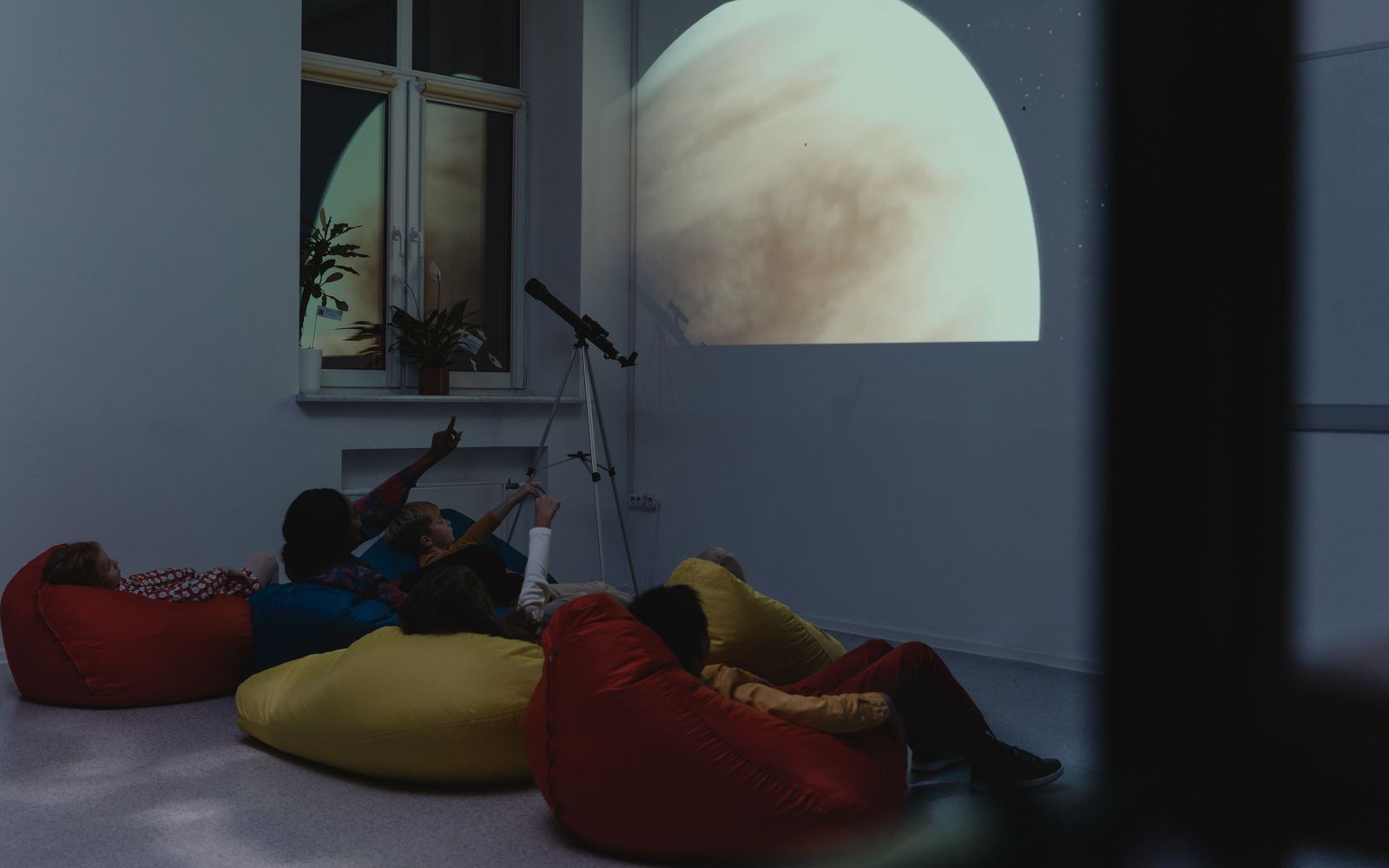
A first astronomy outing is easier to choose once you decide how the evening should feel. At SEE Institute, a talk and planetarium programme lead into telescope viewing, with a scheduled 9pm finish. Dubai Astronomy Group’s Leonids night at Al Qudra starts at 10pm and lasts until 2am. One gives you a subject to follow through a relatively short evening; the other asks you to settle outdoors and spend time watching the sky.
For a first visit with children, the Moon evenings at SEE Institute are the more manageable starting point. Choose the Leonids if everyone actively wants a late desert night and you have the return drive arranged. Neither ticket can guarantee a clear view, but both include explanations and activities beyond looking through an eyepiece.
The programmes below were checked on 8 November 2026. They are dated events, not weekly sessions. All times are Dubai local time, and the prices are the published general and child ticket rates before any membership benefit or additional charge shown at checkout.
Choose the format and finish time
| Experience | Date and time | Published ticket price | Best fit |
|---|---|---|---|
| Beaver Moon at SEE Institute | Tuesday 24 November 2026, 7–9pm; check-in from 6:30pm | AED 100 general; AED 80 under 13 | A first lunar-science evening with a film and telescope session |
| Cold Supermoon at SEE Institute | Thursday 24 December 2026, 7–9pm; check-in from 6:30pm | AED 100 general; AED 80 under 13 | The same broad format on a December date |
| Leonids at Al Qudra | Tuesday 17 November, 10pm, to Wednesday 18 November 2026, 2am | AED 180 general; AED 150 under 13 | A longer outdoor programme with meteor watching and photography |
Dubai Astronomy Group requires advance registration for all three. Use the individual November Moon listing, December Moon listing or Leonids listing to check the date and current ticket availability. A ticket for one does not cover another.
SEE Institute for a first Moon evening
SEE Institute is in The Sustainable City, Dubai. Dubai Astronomy Group’s collaboration with the venue combines projected astronomy programmes, discussion and outdoor observing. Its season announcement describes the November and December lunar events as part of that programme.
The sequence helps if your group includes someone who is curious but has never used a telescope. The talk introduces the subject before you are asked to recognise anything in the sky. The question period gives children and adults a chance to follow up on something they did not understand. You then watch a planetarium programme before moving to the instruments.
Both current event pages publish the same timetable: 6:30pm check-in, 7pm lecture, 7:45pm questions, 8pm planetarium show and 8:30pm telescope observation, finishing at 9pm. Arriving at 8:30pm would miss most of the programme. For a first visit, plan around check-in rather than treating the final telescope slot as the start of the outing.
The film is Back to the Moon, about the Google Lunar XPRIZE and the teams that competed to reach the lunar surface. The November talk is billed around the Beaver Supermoon; December’s around the Cold Supermoon. These are Moon-focused evenings. Someone expecting a general tour of every planet should choose with that narrower subject in mind.
The final half hour is a shared observation period, not a promise of thirty uninterrupted minutes at a telescope for each guest. Ask the organiser about the arrangements if a particular viewing need matters to you. The programme also does not establish that the venue runs a walk-in planetarium show every evening.
For a sense of a previous astronomy gathering here, Dubai Astronomy Group and SEE Venues published this Saturn-event reel on 10 October 2026. It is a retrospective from a different programme. The November and December booking pages, rather than that earlier film, describe what your Moon ticket includes.
Work out the family cost before choosing a date
At either Moon evening, two general tickets cost AED 200. One general ticket and one paid under-13 ticket total AED 180. Two general tickets and two paid child tickets total AED 360. These examples use the displayed AED 100 and AED 80 rates; they are admission calculations, not a meal or transport package.
At the Leonids night, the equivalent totals are AED 360 for two general tickets, AED 330 for one general and one paid child ticket, and AED 660 for two general and two paid child tickets. A family buying those four tickets pays AED 300 more than at either Moon evening, in exchange for a different and longer programme. Decide whether the late outdoor format is what the group wants before using duration alone to judge value.
Dubai Astronomy Group’s general visitor information says under-fives can attend free with a ticketed adult and describes its programmes as most suitable from age five. The Leonids page goes further: it specifically discourages bringing under-fives and requires under-13s to be accompanied by a ticketed parent. For a Moon booking with a very young child, confirm registration and seating arrangements with the organiser; free admission does not tell you how a child will manage the talk or screening.
That same visitor page offers free attendance for People of Determination and a 50% discount for one accompanying guest, arranged through the team. Make the reservation directly and describe any assistance needed. A concession does not establish that every viewing position, outdoor surface or telescope eyepiece suits every visitor.
Al Qudra for a night built around looking up
The Leonids event starts on Tuesday 17 November at 10pm and ends at 2am on Wednesday 18 November 2026. Keep both dates in your plans: the return journey falls on Wednesday morning. This is a substantial evening outdoors, especially for anyone with school or work later that day.
The organiser schedules an introductory lecture, questions, astrophotography and sky mapping, with telescope observation through the night. That gives a group several ways to take part. One person can concentrate on recognising patterns in the sky while another tries photographing a target through a telescope. There is no requirement to arrive with specialist equipment or prior astronomy knowledge.
Dubai Astronomy Group’s official Leonids announcement of 1 November 2026 confirms the date, hours and Al Qudra setting. Its star-filled poster is promotional artwork. It should not be read as a forecast of the number or brightness of meteors you will see.
Meteor watching and telescope viewing are different activities. For meteors, you want a broad view of the sky and patience. NASA’s Leonids observing advice recommends a dark location, allowing roughly half an hour for your eyes to adjust and looking across the sky rather than concentrating only on the constellation Leo. A telescope is useful for a selected object; it is not how you watch a wide area for a passing meteor.
That distinction also helps with photographs. The organiser offers help using a phone through its telescopes, but a photograph of a telescope target and a photograph of a meteor streak require different opportunities. Enjoy the observing first, and ask the operators what your phone can reasonably capture. Do not spend the entire night checking a bright screen while waiting for something overhead.
NASA’s November 2026 skywatching guide points viewers towards the early morning hours around 17–18 November, after moonset. The event’s timetable is an organised visit window. It does not promise that meteor activity will peak during your particular turn outside, or that you will see a stated hourly total.
Arrange the Al Qudra journey before paying
For this Leonids event, the organiser says the access road is paved and a standard car is sufficient. It also explicitly says taxis and public transport cannot reach its event location. Treat those as directions for this gathering, and arrange transport both ways before buying tickets. Do not rely on a general Al Qudra map result as your meeting point.
The precise pin is emailed after registration is confirmed. Save it along with the ticket QR code, which is required at check-in. Decide who will drive home after the 2am finish. If that part of the outing is uncertain, the earlier SEE Institute programme is easier to build an evening around.
Seating, water and hot drinks are listed for the Leonids night. Bring layers and suitable closed footwear, and check any food, toilet or access requirements with the organiser before committing. The supplied refreshments do not establish that dinner is included. The event prohibits smoking, alcohol, pets and open flames or barbecues; plan the visit as an organised astronomy session rather than a separate camping evening.
For SEE Institute, use the pin in your own confirmation too. Ask about the correct entrance, parking or drop-off point and your return collection arrangements. The desert event’s transport restriction does not establish the transport arrangements at this city venue.
Read the weather and cancellation conditions together
The indoor talk and film give the Moon evenings a useful purpose even when outdoor visibility is disappointing. The Leonids night relies more heavily on your willingness to spend time under the actual sky. In either case, decide whether the programme would still interest you if the view were less clear than you hoped.
Dubai Astronomy Group’s refund policy gives a refund for cancellation at least 72 hours before the start, 50% between 24 and 72 hours, and no refund less than 24 hours ahead, for no-shows or for late arrivals. It states that approved refunds have a 5% payment-processing deduction. Requests must be emailed with proof of purchase.
The policy also says poor visibility does not qualify for a refund when an event proceeds. The general contact FAQ describes possible weather rescheduling, but you should not assume clouds automatically move your booking. If the organiser cancels, the policy offers refund, credit or transfer choices; ask how the processing deduction applies to that situation.
Use astro@dubaiastronomy.com or the organiser’s published WhatsApp number, +971 56 700 2612, for a booking-specific question. Confirm any condition essential to your visit before payment, particularly child arrangements, access and transport. Keep the reply with your booking confirmation.
For most first-time families, start with the Moon programme whose date fits and arrive for the full evening. Choose Al Qudra when the late finish and time outdoors are part of the appeal. The better booking is the one your whole group can enjoy through to the journey home.
Comments (0)
No comments yet. Be the first!