

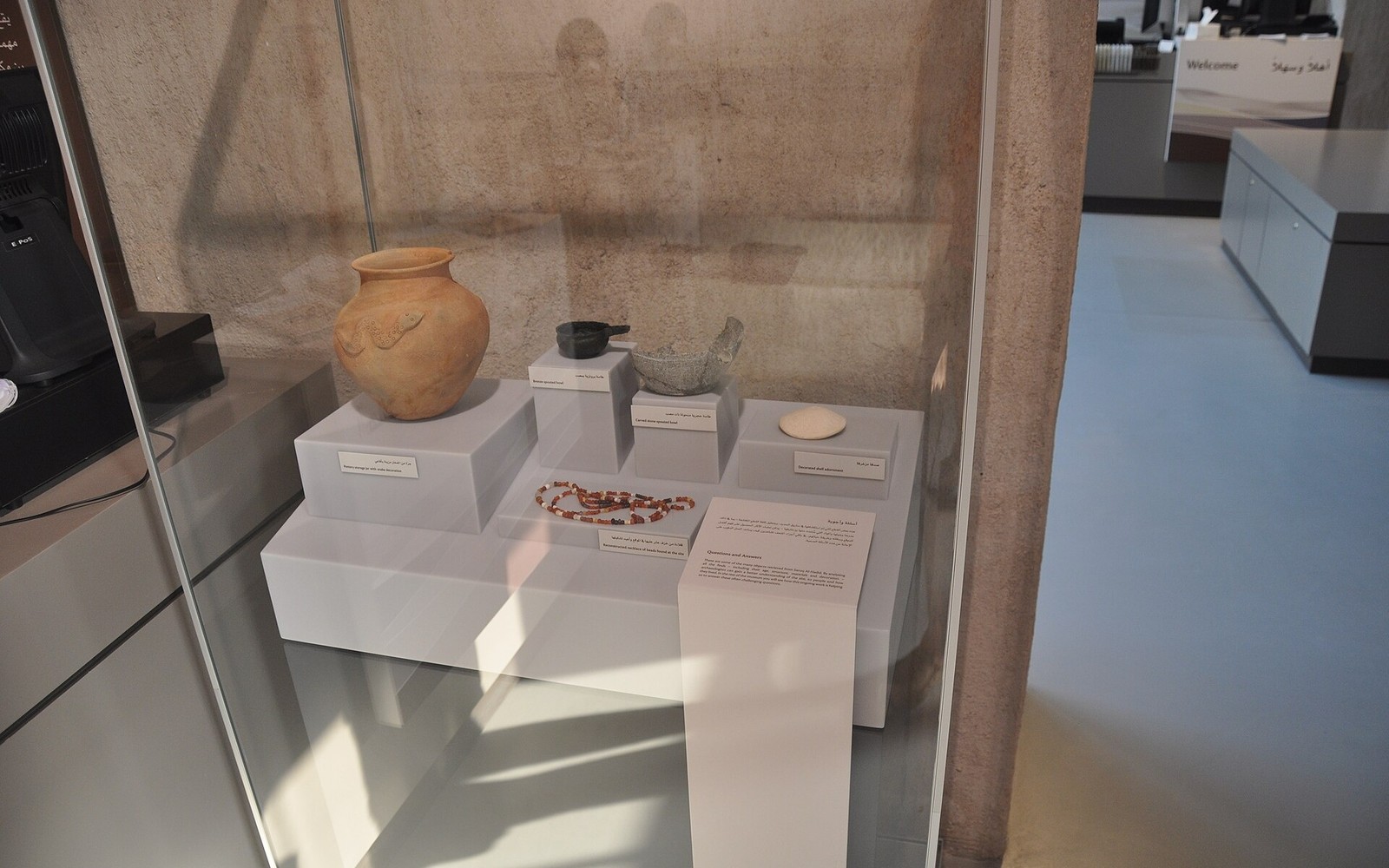
Choose Saruq Al Hadid Museum if you want to look closely at archaeological objects: tools, weapons, vessels, jewellery and clues to connections between ancient communities. The museum is in Al Shindagha beside Dubai Creek. The excavation that supplied its finds is in the desert south of Dubai. Set your destination to the museum house, then make it your first exhibition stop if archaeology is the reason for your visit.
Entry is through Al Shindagha Museum admission, so you can combine Saruq with another house afterwards. There is no need to turn the visit into a tour of the whole complex. A focused look at a tool, an ornament and a clue about trade can be more rewarding than moving quickly through several unrelated subjects.
Visitor information was checked on 8 November 2026. The guide distinguishes the site's archaeological history from what you can plan to do at the museum today.
Find the museum rather than the excavation
The official Al Shindagha visitor map marks Saruq Al Hadid as number 4, near the Creek introduction and Traditional Crafts. The Visitor Centre is number 1. Start there, name the archaeology house and confirm its access before heading through the district.
The National Cultural Map's museum record describes a display of finds from a site associated with copper smelting and the production of tools, weapons and jewellery. Its separate archaeological-site record concerns the place where those objects were excavated. A museum admission ticket should not be treated as permission to visit or participate in the desert excavation.
There is another layer of history in the building itself. Dubai's Protocol Department recorded the museum's opening on 3 July 2016, in the former house of Sheikh Jumaa bin Maktoum Al Maktoum. The heritage residence and the ancient objects belong to different periods. Notice the house, but keep that distinction in mind when reading the dates attached to the finds.
Choose the objects you want to follow
The collection is a good fit for visitors who enjoy asking how something was made or used. You do not need specialist archaeological knowledge to begin. Compare the visible form of an object with the explanation on its label, then look for the evidence behind the interpretation.
| Interest | Objects to look for | A useful question | What to avoid assuming |
|---|---|---|---|
| Making and working | Tools, blades and vessels | How would its shape help it do a job? | Every metal object is iron because the period is called the Iron Age |
| Ornament and identity | Jewellery and beads | How was it worn or fastened? | Its modern appearance tells you its original value |
| Exchange and contact | Seals and materials discussed in the interpretation | Was it made locally or brought from elsewhere? | One imported object proves its owner travelled personally |
| Belief and symbolism | Animal motifs where identified | What supports the museum's interpretation? | A possible explanation is a settled fact |
These are ways to approach the displays, not a list of individual objects guaranteed to be in a particular case. Use the current interpretation to decide which pieces answer your questions. If a label gives a material, date or proposed function, keep those details together rather than remembering only the most striking shape.
Read the metalwork as evidence of skilled production
The UAE Ministry of Culture's archaeological-site account identifies Saruq Al Hadid as an important centre for copper smelting and the manufacture of tools and vessels in the early Iron Age II, which it dates to 1270–800 BCE. It also describes evidence from a wider span of time. The site is not a single event that happened in one year.
The same account lists copper and bronze tools and vessels, gold jewellery and both bronze and iron weapons among the discoveries. The name of the period therefore does not tell you the material of every object. Read the label before comparing two pieces: a similar shape can have been made from different materials, and a material can serve more than one purpose.
Start with one practical object. Look at the edge, handle, opening or place where it might have been attached to something else. Then compare it with a piece made to be worn. The questions change from cutting, holding or containing to fastening, display and personal use. That comparison gives the metalworking theme a human scale without needing to invent a story about a particular owner.
The Ministry records slag, crucible remains and other production evidence at the excavation, alongside finished finds. That distinction matters: the site's importance rests on evidence of making as well as attractive objects. Let the museum's interpretation explain how researchers connect manufacturing traces with the tools and ornaments in the collection.
Look beyond the largest or brightest piece
Small finds can be especially useful when you want to understand contact between communities. The National Cultural Map's excavation record describes stamp seals, some made locally and others imported, and identifies connections with Mesopotamia and ancient Egypt.
If a displayed label discusses origin, distinguish where an object was made from where it was found. Those places can be different, and the route between them may be uncertain. An imported object can reveal a connection without telling you every person or transaction involved in its movement. Read what the museum actually establishes before turning that clue into a complete journey.
Jewellery and beads offer another opportunity to slow down. Look at repeated forms, holes, joining points or surface details, then read how the piece has been interpreted. An object may be visually small while carrying a substantial amount of information about technique or exchange. Give the label as much attention as the photograph you might want to take.
The Ministry also describes a possible association with snake worship at the site. Keep the qualification. If you encounter an animal motif in the displays, separate what is visible on the object from the explanation proposed for it. Archaeology involves interpretation of evidence, and a cautious account is more useful than a dramatic certainty the evidence does not support.
Understand what the interactive visit offers
Visit Dubai's Saruq guide describes a cinematic introduction, projected video, interactive screens and a simulated excavation with objects buried in sand. These can help visitors connect the display cases with the process of discovery. Confirm the elements operating on your day if a particular activity is central to the visit.
The simulated dig is a museum activity. It is not access to the archaeological site and should not be presented to children as participation in a working excavation. For a family, it can provide a starting question: how does finding an object differ from deciding what it means?
In the galleries, let a child choose a tool or ornament and suggest a use before reading the label together. Ask what made them think that: a point, a hole, an edge or a repeated pattern. Then compare the guess with the explanation. This makes the object the centre of the visit, even if an interactive station is unavailable or the child prefers looking to digging.
If your group wants a hosted school visit or specialist explanation, ask the museum about current arrangements and language before planning around it. The public descriptions establish the exhibition's themes; they do not promise a guide waiting for each arriving party.
Buy the correct admission category
Visit Dubai directs Saruq visitors to the Al Shindagha ticket channel. The published admission schedule lists AED 50 per individual, AED 40 per person for groups of five or more, and AED 20 for full-time students aged 5–24. The current booking selector also showed AED 50 adult and AED 20 student tickets for 9 November 2026 when checked.
The student concession is not an automatic child or under-25 rate. Establish eligibility for your party before booking. Children under five are exempt; the schedule also provides exemptions for People of Determination accompanied by one escort, senior UAE citizens and valid ICOM members. Ask which supporting documents are accepted.
Two standard adult tickets total AED 100. Two adults and two qualifying full-time students total AED 140. Five adults qualifying for the group category total AED 200. These figures cover the published admission categories, not transport, refreshments or a separately arranged programme.
Use the current Al Shindagha booking route rather than an old standalone Saruq price found in a historic guide. The ticket channel describes one-day entry to the museum exhibits. If you are travelling specifically for Saruq, confirm that the house is accessible on your date before paying; general admission to a complex is not proof that every exhibition space is operating.
Arrive with time for the house you came to see
Al Shindagha's published hours are 10am–8pm daily, with last ticket sale at 7pm. Start earlier if you want to read the displays closely or add another house. Confirm any house-specific access arrangements with the Visitor Centre rather than assuming the final ticket-sale time leaves a full visit available.
The museum map identifies Al Ghubaiba Metro Station, bus station and ferry terminal as nearby arrival points. Visit Dubai's Al Shindagha guidance identifies the Metro's Green Line. Choose the museum Visitor Centre as your destination for the final approach, then use the map number and house name for Saruq.
Al Shindagha Museum's official arrival reel provides visual orientation to the wider complex. Published in August 2025, it illustrates arrival options rather than Saruq's individual exhibits or today's transport timetable. The museum can confirm visit arrangements on 800 33222 or alshindagha@dubaiculture.ae.
For mobility needs, explain that Saruq is your priority. The wider museum brochure describes step-free access to most houses and staff assistance, but that does not establish the exact route or equipment available for this house. Ask about the approach, interior access and suitable rest points before building a longer itinerary around it.
If you want a second exhibition, the map places Dubai Creek Birth of a City nearby. It changes the focus from ancient desert finds to the later story of the city and waterway. Traditional Crafts offers a different continuation through making, but should not be read as proof of an unbroken line from every ancient technique. Choose one connection that interests you, and leave time for the archaeological objects that brought you here.
Comments (0)
No comments yet. Be the first!