

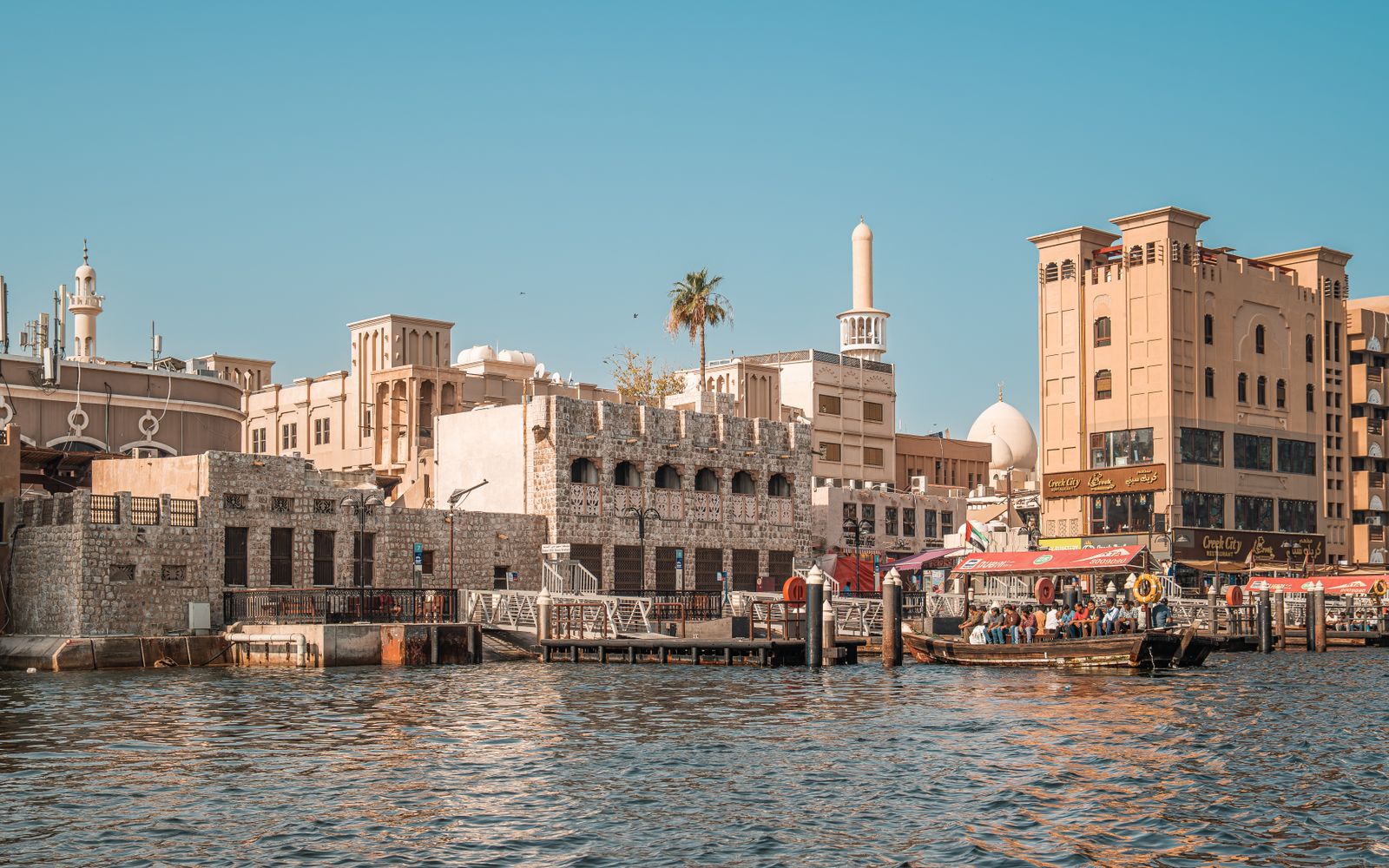
For a first visit to Old Dubai, start in Al Fahidi, take a public abra across Dubai Creek and finish in Deira’s souks. Keep Al Shindagha Museum as a deliberate addition: it is on the Bur Dubai bank, so visiting it before the crossing adds a detour and needs a substantial part of the day. If you have only a few hours, the neighbourhood walk and souks make a more manageable plan.
This guide helps you choose the order, the crossing and the amount of museum time. It covers public streets and transport, with no requirement to book a tour or buy anything in the markets. The visit allowances below are planning suggestions, not measured journey times. Transport fares, museum admission guidance and the linked operator information were checked on 8 November 2026; confirm the service and ticket for your travel date.
Choose the version that fits your day
| Plan | Main stops | Suggested allocation | Main paid element |
|---|---|---|---|
| Neighbourhoods and souks | Al Fahidi, public abra, Deira | Half a day, with a food break | Abra fare and your own purchases |
| Museum and neighbourhood | Al Shindagha, then Al Fahidi | Give the museum 2–3 hours before adding the walk | Museum admission |
| Full route | Al Fahidi, Al Shindagha, public abra, Deira | A full day with breaks and extra walking | Museum admission and abra fare |
Choose Al Fahidi if you mainly want lanes, courtyards and traditional architecture. Choose Al Shindagha if you want exhibits explaining the history behind the buildings and the Creek. Choose Deira if browsing shops and seeing the trading district is the main attraction. You can enjoy any of these without completing the others.
The full route is most useful when everyone wants a museum visit as well as the souks. If one person wants several hours of exhibits and another mainly wants to shop, settle that difference before buying tickets. A museum visit squeezed between a long lunch and a late crossing is unlikely to give either person enough time.
For a shorter outing, keep to Al Fahidi and Deira. For a museum-focused outing, start at Al Shindagha and finish on the same bank in Al Fahidi. That second option also avoids making a boat crossing essential to the day. It is a sensible fallback if the weather, a service interruption or someone’s mobility needs make the crossing unsuitable.
Start with a walk through Al Fahidi
Al Fahidi Historical Neighbourhood sits beside Dubai Creek. Visit Dubai describes more than 50 historic houses and highlights the district’s wind towers, cultural institutions and galleries. That does not mean every building is a museum you can enter at any time. Treat the public walk and each individual attraction as separate parts of the visit.
Allow roughly one to two hours for a first look, with more time if you book a cultural experience or enter several venues. Walk through the lanes before choosing where to stop. Look at the relationship between the narrow passages, enclosed courtyards and towers above the roofs; these architectural details give the neighbourhood a clear focus even without a paid activity.
A hosted visit changes the rhythm of the morning. It brings a fixed meeting place and start time, whereas a self-guided walk lets you shorten the visit if the group is hot or tired. If you book anything, place that appointment first in your plan and build the optional stops around it. Do not assume that a district visit includes a meal, museum entry or a guide.
Keep a food and water break in the plan, but choose it according to where you actually finish the walk. Before sitting down, check the menu and service arrangements, especially if you have a museum booking later. A short stop can easily become the longest part of an otherwise compact route.
Treat Al Fahidi Fort as an exterior stop
Al Fahidi Fort is nearby, but do not build the day around entering its museum. Its profile still described the opening as forthcoming when checked, and the government’s earlier restoration announcement gave a planned opening rather than proof of current admission. Add an interior visit only after Dubai Culture confirms that it is open for your date.
The fort’s heritage reel uses a historical visualisation of the fort and its surroundings. It gives context for the landmark; it is not a photograph of today’s visitor access or an admission announcement. For current arrangements, use Dubai Culture’s contact details on the official Al Fahidi listing or call 800 33222.
Decide about Al Shindagha before crossing
Al Shindagha is on the same bank as Al Fahidi, farther towards Al Ghubaiba. If it is part of your day, visit before going to Deira. The optional museum leg involves extra movement along the Bur Dubai side and a return towards your chosen crossing. A route that starts in Al Fahidi and adds the museum is therefore not a straight walk from the first stop to the last.
Al Shindagha Museum’s official visitor information describes the Dubai Creek story and the Perfume House. The museum spreads across historic houses, so plan for movement between buildings as well as time inside exhibits. Ask at the Visitor Centre which houses are operating and which fit your interests. A published list of houses is not a guarantee that every space or activity will be available during your visit.
Allow two to three hours as a starting point if you want several houses. The Creek exhibits are a useful priority for this itinerary because you will later cross the water and walk through Deira’s trading streets. The Perfume House offers a more focused subject if you prefer choosing a second theme instead of trying to see everything. These are suggested priorities, not an official tour sequence.
Hours and the ticket you actually need
The museum’s visitor brochure lists daily opening from 10am to 8pm, with the last ticket sale at 7pm. Its current Instagram profile also gives 10am–8pm and a 7pm cutoff. Treat 7pm as a deadline to verify, not a good arrival target for a substantial visit. The brochure is an older document, so check current arrangements before setting out.
The published admission schedule lists AED 50 per individual, AED 40 per person for groups of five or more, and AED 20 for full-time students aged 5–24. The student category is not a general child or young-adult price. Confirm the evidence required and the ticket that applies to your party.
Use the booking link on Visit Dubai’s museum page to reach the current ticket channel. Do not use the old ticketing hostname printed in the brochure. If booking is unavailable, call 800 33222; the brochure also identifies ticket desks at the Visitor Centre, Culture of the Sea Pavilion and Poetry House. Confirm that your intended desk and houses are operating before making a special journey.
The museum’s August 2025 arrival reel shows transport guidance for reaching the district, including Al Ghubaiba. It is historical orientation. Use current RTA information to establish whether a particular bus, ferry or Metro journey works for you; the reel does not establish a current route from every departure point.
Choose the correct abra crossing
For the direct connection from Al Fahidi Marine Station to Deira Old Souq Marine Station, RTA’s Creek service page lists CR5 at AED 2 per person per trip. This is the most straightforward crossing to identify when following the main Al Fahidi-to-Deira plan. Check the station name as well as the word “abra” before joining a queue.
Use the timetable for your boarding station. RTA’s September 2026 detailed abra timetable lists Al Fahidi to Deira Old Souq from 8am Monday–Thursday and Saturday, 8:30am Friday, and 9:30am Sunday, ending at 11:30pm in that direction. The reverse direction has different times. The general Creek page gives broader route hours and an earlier Friday start, so follow the direction-specific timetable and confirm the actual departure with station staff. Allow for waiting and recheck public-holiday or Ramadan changes. Cash, nol and bank cards are listed for this service.
A separate RTA page for traditional abras lists CR1 from Bur Dubai Abra Station to Deira Old Souq and CR2 from Dubai Old Souq to Al Sabkha at AED 1 per passenger per trip, cash only. These station pairs matter. Bur Dubai Abra Station, Dubai Old Souq and Al Fahidi Marine Station are not interchangeable names for one boarding point.
For this itinerary, CR1 can be an alternative when its Bur Dubai departure point fits your walk. CR2 arrives at Al Sabkha, so using it changes where you start on the Deira bank. Decide whether that arrival suits your intended market rather than choosing only by the one-dirham fare difference. Ask station staff if the boat’s destination is unclear.
Carry small cash if you want the traditional one-dirham option. A private boat hire is a different purchase from a public crossing; confirm the product before paying. You do not need a private sightseeing trip simply to reach the opposite bank. If the group splits between boats or queues, agree on the named arrival station and meeting point before boarding.
RTA’s October 2026 abra post shows boats against Old Dubai’s waterfront. Its caption also refers to Dubai Water Canal services, so use it as general visual context. The route pages above establish the Creek station pairs and fares used here.
Walk from Deira’s waterfront into the souks
After arriving at Deira Old Souq, choose the market that interests you most instead of trying to visit every lane. Gold, spices and perfume lead to different shops and different kinds of browsing. Allow one to two hours for a first look, then adjust for shopping, a food break and your return journey.
Visit Dubai’s Deira guide connects the area’s commercial role with its traditional dhow wharfage. Its Creekside guide provides further context for the waterfront and markets. Keep to public streets and visitor areas. Working boats and quays are part of the setting, not an invitation to board or enter operational spaces.
There is no single market-wide timetable that guarantees every shop will be open. If a particular purchase is the purpose of the trip, confirm that trader’s hours before going. For a general visit, leave the sequence flexible: look at the waterfront, browse the lanes that appeal to you and stop when the group has had enough.
For purchases, ask for the complete price before agreeing. With jewellery, clarify the item, weight, making charges and any other charges included in the quote. With spices or perfume, confirm the quantity and packaging rather than comparing two prices for different amounts. Keep receipts, and check your destination’s import rules if you intend to carry purchases abroad.
If you are only browsing, there is no need to invent a shopping list to justify the visit. A short market walk can be enough after the museum and crossing. Leave room in your bag if you do plan to buy, and reconsider a long walk back if the purchases are heavy. This is another reason to choose the return journey before reaching the end of the day.
Budget for the route you choose
Separate transport and admission from food, shopping and travel to the area. For two adults paying the full CR5 fare, one crossing costs AED 4 in total. Crossing back on the same fare basis brings that to AED 8. Two AED 50 museum tickets add AED 100, making AED 104 for the museum plus a one-way CR5 crossing, or AED 108 with the return crossing.
Those examples are limited subtotals. They exclude Metro or taxi travel, meals, paid cultural experiences, purchases and any booking charges shown at checkout. They also assume standard individual museum tickets and no concession. A family, student party or qualifying group should calculate using the ticket categories that actually apply rather than multiplying the adult example blindly.
The museum is the larger commitment in this comparison. Choose it for the exhibits, and allow enough time to use the ticket well. If the group mainly wants an outdoor walk and the markets, Al Fahidi, an abra crossing and Deira form a complete outing without that admission cost. Spending less does not require filling the day with additional stops.
Arrival access and a comfortable return
The museum brochure identifies Al Ghubaiba Metro Station, bus station and ferry terminal for Al Shindagha. For Al Fahidi, the official visitor directions identify Sharaf DG Metro Station nearby. Check the walk to the exact entrance you want; a station serving a district does not place you at every attraction’s door.
If the museum is your priority, arriving at Al Ghubaiba and starting there can save the initial Al Fahidi-to-museum detour. If the souks are the priority, start with Al Fahidi and cross when ready. On the Deira side, choose your onward Metro or taxi departure according to where you finish shopping, rather than automatically retracing the entire walk.
Much of the route is outdoors. Plan a shaded or indoor break, carry water and shorten the walking sections when conditions are uncomfortable. For children, make one main indoor visit or market stop the priority and treat the rest as optional. For anyone who needs step-free access, confirm the exact museum houses and the intended boat boarding arrangements before relying on this plan.
The brochure says most museum houses have step-free access and mentions staff and mobility-buggy assistance. That is useful starting information, not a guarantee about every building or the whole outdoor route. Contact the museum about the particular facilities needed. If the crossing cannot meet those needs, the museum-and-Al-Fahidi option keeps the visit on one bank.
Comments (0)
No comments yet. Be the first!